
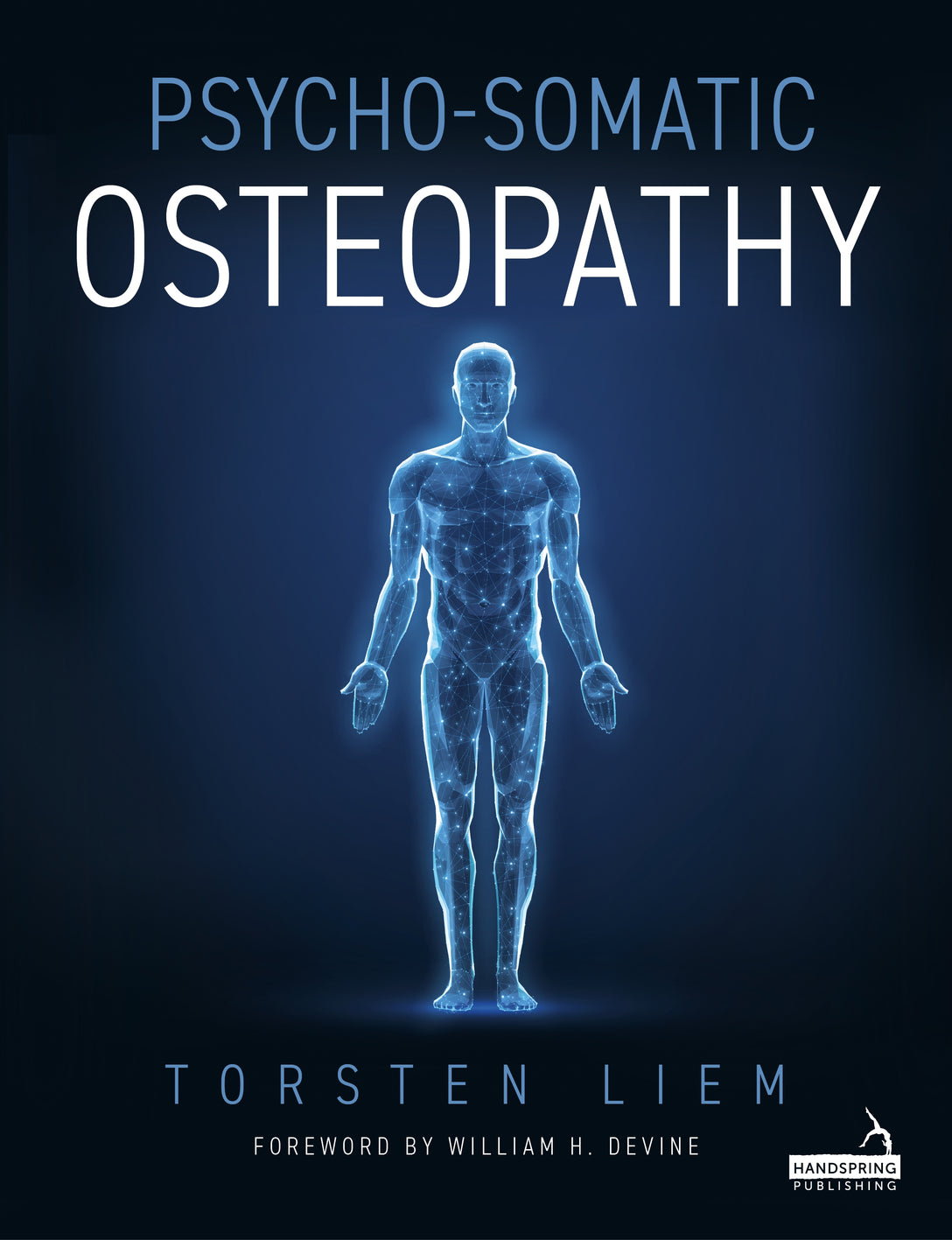
Psycho-somatic Osteopathy
- Author
- Foreword
Regular price
$195.00
Regular price
Sale price
$195.00
Unit price
per
- ✔️ Free US delivery over $45
- ✔️ Careful, protective packaging
- ✔️ Direct from the publisher

Introducing Psycho-somatic Osteopathy's central principles, diagnostic and therapeutic frameworks, this comprehensive book gives an in-depth overview of this emerging field. Psycho-somatic osteopathy (PSO) is used to treat a variety of conditions that lie at the intersection between psychological and physical complaints, including post-traumatic stress, emotional regulation disorders, chronic pain, and brain injury.
Expert in Psycho-somatic Osteopathy and practising osteopath Torsten Liem covers not only the foundations of PSO but describes newly developed approaches and techniques, and how to use them to treat specific populations and conditions. These newly developed approaches include osteopathic heart-focused palpation (OHP), osteopathic bilateral stimulation (OBS), osteopathic emotional regulation technique (OER), multimodal bifocal integration (MBI) and osteopathic felt sense (OFS).
A detailed and practical guide to implementing PSO treatment structures and clinical procedures, this book is an invaluable resource for both new and experienced osteopaths aiming to develop their practice.
Expert in Psycho-somatic Osteopathy and practising osteopath Torsten Liem covers not only the foundations of PSO but describes newly developed approaches and techniques, and how to use them to treat specific populations and conditions. These newly developed approaches include osteopathic heart-focused palpation (OHP), osteopathic bilateral stimulation (OBS), osteopathic emotional regulation technique (OER), multimodal bifocal integration (MBI) and osteopathic felt sense (OFS).
A detailed and practical guide to implementing PSO treatment structures and clinical procedures, this book is an invaluable resource for both new and experienced osteopaths aiming to develop their practice.
- Published: Jan 21 2027
- Pages: 544
- ISBN: 9781399830485
Press Reviews
Jean-Pierre Barral, DO
Torsten Liem presents an original clinical framework integrating the dynamic interactions of soma, physiology, experience, and context into osteopathic practice. His thoughtful approach enriches clinical reasoning and provides valuable clinical perspectives for understanding and treating complex patient presentations.
Dr Raymond N. Perrin DO, PhD, Neuroscientist, Registered Osteopath, Adjunct Professor of Osteopathic Manipulative Medicine at NYIT
Torsten Liem, together with contributions from other leading lights in osteopathic philosophy, education and research, has made a decisive step forward in osteopathy-integrating neurophysiology, immunology, and patient interaction within a practical, palpatory model. It challenges us to think wider, engage deeper, and recognise co-regulation as central to effective treatment. This is an ambitious, thought-provoking, and ultimately important contribution that will certainly influence the future direction of osteopathy.
Robert Schleip, Prof. Dr. biol.hum., Senior Scientist, Technical University of Munich, Germany
Torsten Liem once again demonstrates his remarkable ability to integrate diverse perspectives into a coherent clinical framework. By venturing into the still largely uncharted territory at the interface between osteopathy, neuroscience, psychology, and manual therapy, this book represents an important pioneering contribution. It offers fresh perspectives and a rich source of inspiration for osteopaths interested in the interplay between body, mind, and therapeutic touch.
Simeon Niel-Asher BPhil, BSc (Ost) MIRO - Osteopath
This is an ambitious attempt to formalize something many experienced osteopaths do intuitively - reading a patient's emotional and biographical context alongside their tissue findings - into a teachable clinical framework. Its real strength is scope: it pulls together attachment theory, polyvagal/stress physiology, and osteopathic principle in one place, and the case-study material and staged treatment structure should be genuinely useful for clinicians wanting a repeatable process rather than vague holism.